

Matilda-Award
The Gender Equality Commission of the Faculty of Human Sciences gives two awards for female junior researchers of this Faculty. The wide range of academic disciplines within the Faculty will be taken into account in the selection process.
The award is designed to advance the careers of female junior researchers as well as female doctoral and Habilitation candidates at the Faculty of Human Sciences.
The cash prize of €1,000 may be used for research activities.
Nominations will be evaluated according to originality and scientific contribution to the respective field of study.
The name refers to the Matilda effect, which describes the phenomenon that the scientific contributions of women are often less recognised than those of their male colleagues. The term was coined by the historian Margaret W. Rossiter and is named after the women's rights activist Matilda Joslyn Gage. This effect means that women in science are often overlooked, or their achievements are attributed to men.
Call for applications for the Matilda-Award presented by the Gender Equality Commission of the Faculty of Human Sciences
The Gender Equality Commission of the Faculty of Human Sciences will give two Best Paper Awards for female junior researchers at this Faculty. Each award comes with a cash prize of €1,000. The wide range of academic disciplines within the Faculty will be taken into account in the selection process. For the sixth year the Matilda-Award 2025 is designed to advance the careers of female junior researchers as well as female doctoral and Habilitation candidates at the Faculty of Human Sciences.
Contributions can be submitted in scientifically relevant publication media of the respective disciplines (e.g., journal articles, contributions to edited volumes) that have been published by early-career researchers as first authors and affiliated with JMU as specified. Selection for the award will be based on the originality of the paper and its impact on the discipline in question as well as on diversity and excellence of research at the Faculty of Human Sciences, i.e. impact factor alone is not decisive. To be eligible for the award papers must have been published in 2024 or later. Papers that have been accepted for publication are also eligible.
The selection process by the Faculty’s Gender Equality Commission will take place in the summer semester 2025 and will strive to take into account the research and publication culture in all scientific disciplines at this Faculty. Awardees will be notified as soon as their selection for the award has received approval from the Dean. The prize money may be spent on research activities according to the funding guidelines of the University of Würzburg (conference attendance, research subject fees, student tutors etc.).
Application requirements:
- The nominated paper
- Information about the paper (2 pages max.) stating
- relevance of the journal or edited volume (e.g., peer review, impact factor),
- which contribution the applicant has made in the case of two or more authors:
- how the paper impacts and advances the applicant’s field of research,
- the paper’s impact beyond the discipline in question,
- allocate the paper to its scientific study category (e.g., quantitative research, qualitative research, literature reviews, hermeneutic approach).
- Intended use of the prize money
- Proof that the applicant’s employment contract with the University of Würzburg will end no earlier than the expenditure of the prize money
Please email your complete application as a single file PDF document to gleichstellung.hw@uni-wuerzburg.de. The closing date for applications is 18 March 2025.
Sincerely,
Prof. Dr. Verena Haun
(Women’s Representative of the Faculty of Human Sciences) on behalf of the Faculty’s Gender Equality Commission
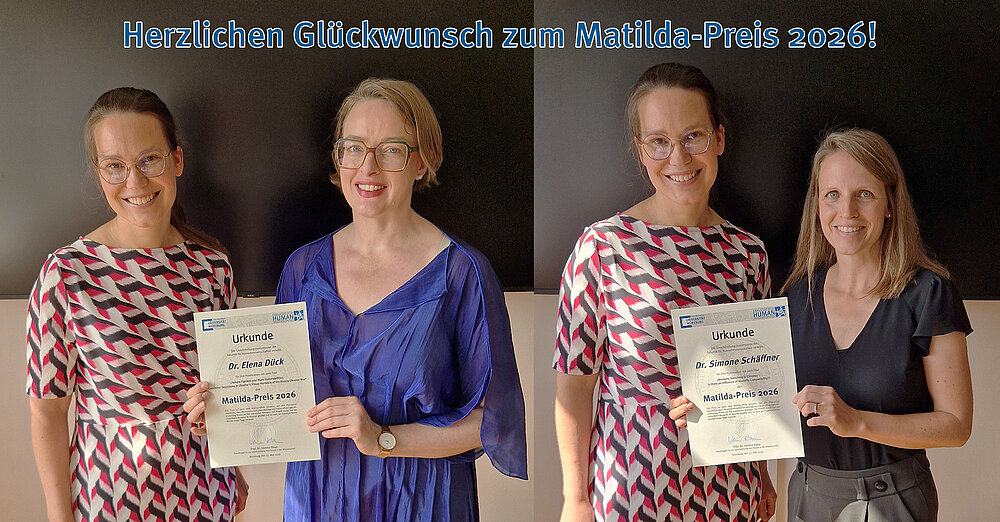
Dr. Elena Dück
Dr. Elena Dück is being honored for her paper “Female Fighters and Male Vulnerabilities. Gendered Depictions in Ukraine’s Visual Narrative of the Russia-Ukraine War.”
The paper uses visual narrative analysis to examine depictions of female and male soldiers in Ukrainian social media communications following the start of Russia’s full-scale invasion. The focus is on the systematic evaluation of visual material to identify gender roles and their portrayal in the context of war. The analysis demonstrates how visual narratives both reinforce and transform traditional gender roles. The paper combines this methodological perspective with approaches from narrative research and feminist theories. Furthermore, it provides an important impetus for greater consideration of visual data in the field of International Relations.
Dr. Simone Schäffner
Dr. Simone Schäffner of the Chair of Special Education and Therapy in Language and Communication Disorders at the Institute for Special Education is being honored for her research article “Modality Switching in Children – Is there an Influence of Modality Compatibility?”
The article reports on an empirical-quantitative study in which 64 children performed linguistic multitasking tasks across four modalities in two reaction time experiments. For the first time, the modalities of hearing, seeing, speaking, and manual responses were systematically combined and examined for their compatibility in children. The results clearly show that compatible modality combinations lead to faster and more error-free switches than incompatible ones. Thus, the study demonstrates the central importance of modality compatibility for children’s language processing. At the same time, through its integrated experimental design, it provides important new insights for the further development of psycholinguistic models.
| Year | Awardee | ||
|---|---|---|---|
| 2026 | Dr. Elena Dück (International Relations and European Studies) | ||
| Dr. Simone Schäffner (Pädagogik) | |||
| 2025 | Dr. Maria Pfeiffer (Psychology) | ||
| Nea Solander (International Relations and European Studies) | |||
| 2024 | Franzisca Maas (Psychological Ergonomics) | ||
| Dr. Wienke Wannagat (Psychology) | |||
| 2023 | Tanja Messingschlager (Psychology of Communication and New Media) | ||
| Sara Wolf (Psychological Ergonomics) | |||
| 2022 | Dr. Catharina Tibken (Psychology) | ||
| Dr. Sonja Schierbaum (Philosophy) | |||
| 2021 | Lea Goldan (Quantitative Methods of Empirical Social Research) | ||
| Dr. Ann-Kristin Herget (Media and Business Communication) | |||
| 2017 | Anja Kürzinger (School Pedagogy/Primary Education) | ||
| Dr. Kristina Suchotzki (Psychology) | |||
| Jennifer Tiede (School Pedagogy) | |||
| Year | Awardee |